

How DDP Shipping from China Works: Risks, Insurance & Compensation?
DDP shipping from China sounds simple: you pay one shipping price, and the logistics company takes care of transportation, customs clearance, duties, taxes, and final delivery.
For Amazon sellers, wholesalers, and small businesses importing products from China, this can be extremely convenient.
But there is an important question that many buyers overlook:
What happens if your DDP shipment is delayed, stopped by customs, damaged, or lost?
Not all DDP shipping services work in the same way. More importantly, DDP itself does not automatically mean your cargo is fully insured or that every shipping problem will be compensated.
In this guide, we explain how DDP shipping from China works, the difference between legitimate DDP and less transparent DDP channels, common transportation risks, insurance options, compensation standards, and what you should confirm before shipping.
Table of Contents
Is China DDP Shipping Legit
DDP shipping is widely used in global B2B transactions. The problem is that some Chinese suppliers may use the term DDP for different types of shipping arrangements, some of which may not follow the standard DDP structure.
What is Standard DDP Shipping from China?

In a Duty Paid Delivery – DDP shipping terms, the seller delivers the goods to a place designated by the buyer’s country and pays import duties, including inland transportation from the point of entry to the buyer’s location.
There are many different shipping options available for DDP shipments, depending on the origin and destination of the goods, the size and weight of the shipment, and the buyer’s requirements.
Some of the most common shipping options for DDP shipments include: Airfreight, Sea freight,Courier services…
I’m afraid when it comes to such offers. We always go back to the old truth that if it looks too good to be true? Suppose you want to use Alibaba to import goods from China for sale on Amazon, eBay, or elsewhere.
You should read this article very carefully because you are likely to be breaking the law and may face serious problems due to Tax evasion.
Does that sound scary? I agree. Let’s look for all about DDP Incoterms and how you use it and can’t use it in your import business.
What Is “Gray DDP” Shipping?
In the China logistics industry, you may hear terms such as “gray customs clearance,” “gray DDP,” “special DDP lines,” or “double clearance and tax included.”
These terms should be used carefully.
DDP itself is not illegal or “gray.”
The risk comes from how a particular logistics channel actually handles customs clearance, declarations, duties, documentation, and the importer-of-record structure.
Some low-cost DDP channels may involve practices such as unclear customs declarations, unusually low declared values, unclear import documentation, or other arrangements that are difficult for the buyer to verify.
For this reason, buyers should not judge a DDP service only by its price.
Properly Structured DDP vs. Non-Transparent DDP
| Comparison | Properly Structured DDP | Non-Transparent / Higher-Risk DDP |
|---|---|---|
| Basic Structure | Follows the agreed DDP responsibilities, with the seller or designated party handling import clearance and applicable duties and taxes. | Uses “DDP” mainly as a door-to-door, low-cost shipping solution without clearly explaining the actual customs and import arrangements. |
| Import Customs Clearance | clear arrangement for how and by whom import clearance is handled. | The buyer may not know who actually handles customs clearance. |
| Importer / Importing Party | The party responsible for the import process can be clearly identified. | The actual importing party may not be transparent to the buyer. |
| Customs Declaration | Product information, declared value, HS Code, and other relevant information are clearly addressed. | Product descriptions or declared values may be unclear, with potential risks such as undervaluation or inaccurate declarations. |
| Duties & Taxes | It is clear who is responsible for import duties, VAT, and other applicable taxes. | The provider may simply say “tax included” without clearly explaining how duties and taxes are handled. |
| Documentation | The parties can clearly agree on what commercial, shipping, and customs documents are available. | Documentation may be limited, unclear, or difficult for the buyer to verify. |
| Price | The quotation generally reflects transportation, customs clearance, duties/taxes, and the associated logistics costs and risks. | The price may be unusually low compared with the expected cost structure. |
| Customs Inspection | The provider explains how customs inspections, delays, and other abnormal situations will be handled. | The service may simply promise “customs clearance included,” with responsibility discussed only after a problem occurs. |
| Transportation Risk | The seller bears the relevant transportation risk up to the agreed delivery point. | Actual compensation may still be limited by the forwarder’s specific terms and conditions. |
| Insurance | Insurance can be purchased separately, with clear coverage, exclusions, and limits. | Buyers may mistakenly assume that “DDP” automatically means the cargo is fully insured. |
| Loss Compensation | Compensation standards and maximum limits are agreed before shipment. | Compensation may only be discussed after the cargo is lost. |
| Damage Claims | There is a clear claim procedure, deadline, and evidence requirement. | The claim process and compensation rules may be unclear. |
| Delivery Delays | The parties understand which delays are normal transportation risks and how exceptional situations are handled. | Buyers may assume that “DDP” means the shipment must arrive on time under all circumstances. |
| Customs Detention / Inspection | Responsibility and cost allocation are discussed before shipment. | The shipment may experience a long delay while the buyer has limited visibility into who is responsible. |
| Buyer Control | Responsibilities, costs, and risk boundaries are relatively clear. | The price and service may look simple, but the actual risks and responsibilities may be difficult to see. |
| Best For | Buyers who want a simpler import process but still value transparency, documentation, and clearly defined responsibilities. | Buyers who focus mainly on the lowest possible shipping price and are willing to accept greater uncertainty. |
| Key Characteristic | Transparent, explainable, and clearly defined responsibilities. | Convenient and potentially cheaper, but with less transparency and greater uncertainty. |
Why Do Many Freight Forwarders in China Prefer “gray-area” DDP Terms?
A low price alone does not prove that a DDP service is “abnormal” or unsafe.
Some logistics providers may offer lower prices because of shipment consolidation, higher shipping volumes, better carrier rates, or more efficient transportation arrangements.
If a freight forwarder refuses to handle DAP or DDP using the buyer’s own tax ID/EORI and does not provide proper customs documentation, it may be because this type of shipment requires more operational work, creates greater transparency, and leaves less margin for the forwarder.
If you do not require formal customs documentation and choose a simplified DDP channel instead, the service may be cheaper and easier.
However, you should clearly understand how customs clearance is handled and, more importantly, what happens if the shipment is lost, seized, delayed, or damaged.
The key is not simply to ask, “How cheap is the DDP?”
Instead, ask:
“How does this DDP shipment actually work, and what happens if something goes wrong?”
Most importantly, agree on the compensation terms before your goods leave China. Do not wait until the cargo is lost, damaged, delayed, or detained to find out how much compensation you can receive.
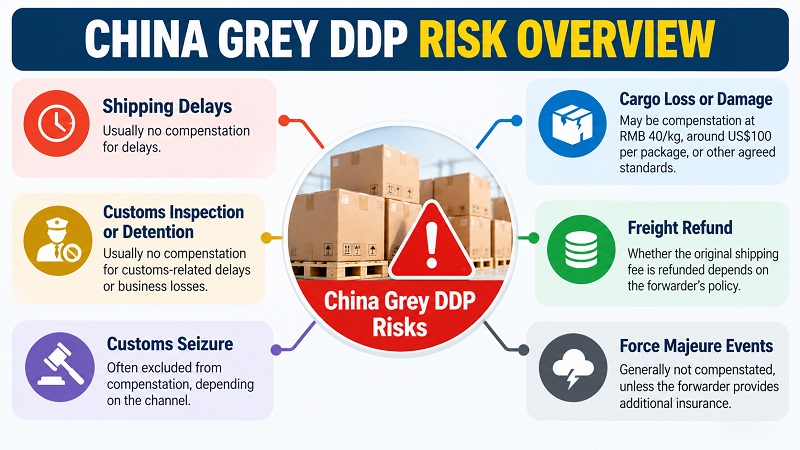
Does China DDP Shipping Include Insurance?
No. DDP does not automatically mean that your goods are fully insured.
This is a common misunderstanding.
DDP defines responsibilities between the parties, but insurance should be considered separately.
Therefore, buyers should ask two different questions:
Who is responsible for the transportation risk?
and
What insurance or compensation is actually available if something goes wrong?
These are not necessarily the same thing.
Comparison of Simplified Compensation Agreements for DDP Shipping from China:
| Situation | What Happens if the Cargo Is Lost or Damaged? |
|---|---|
| Normal DDP without additional insurance | Compensation depends on the DDP provider’s contract, the actual carrier’s liability limits, and the applicable shipping terms. |
| DDP + Declared Value | The carrier’s potential liability limit may be increased, but this does not mean the shipment is fully insured. |
| DDP + Cargo Insurance | A claim can be made according to the insurance policy, including its coverage, exclusions, deductible, and maximum insured amount. |
| DDP + Specific Compensation Agreement | Compensation follows the terms agreed between the buyer and the DDP provider before shipment. |
| Non-transparent DDP without clear written terms | The biggest problem is uncertainty: Who is responsible, what is covered, and how much will actually be paid? |
Typical Compensation Amount for Non-Transparent DDP Shipping from China:
For some non-transparent or simplified DDP channels in China, compensation is often not based on the full commercial value of the goods.
Instead, the forwarder may use a predetermined compensation standard, such as:
| Common Compensation Method | Typical Example |
|---|---|
| Weight-based compensation | Around RMB 40/kg |
| Per-package compensation | Around US$100 per package |
| Freight-based compensation | In some cases, compensation may be around 2× the shipping fee |
| Freight refund | Depends on the forwarder’s terms and usually needs to be confirmed separately |
Delays Usually Do Not Mean Compensation
This is an important point that buyers often misunderstand.
A DDP forwarder may be responsible for arranging transportation and customs clearance, but this does not necessarily mean that the buyer will be compensated for every delay.
In many simplified DDP channels, the shipping fee and cargo value are treated separately from indirect losses caused by delays.
For example, if a shipment arrives two weeks late and the buyer loses sales because the products were not available, the buyer generally should not assume that the forwarder will compensate for the lost profits.
Customs Detention Is an Even Bigger Risk
Another important issue is customs inspection or detention.
If customs holds a shipment for inspection, additional documentation, product verification, valuation, or other clearance procedures, the shipment may be delayed for an extended period.
In some DDP channels, customs detention, seizure, or clearance-related problems are excluded from the insurance compensation policy.
Some DDP Forwarders May Provide Additional Protection
It is also worth noting that some freight forwarders may purchase additional insurance or arrange special risk protection for their DDP shipping channels.
Depending on the forwarder and the specific route, this may include certain risks such as:
- Customs detention or inspection
- Customs-related losses
- Certain force majeure events
- Cargo loss or damage
- Other exceptional transportation risks
However, these protections are not automatically included in every DDP shipment. Coverage can vary significantly between forwarders, shipping routes, products, and insurance policies.
In some cases, the protection may be arranged directly by the freight forwarder rather than purchased separately by the customer.
Therefore, if you are considering a DDP service, it is important to discuss these issues with your sourcing agent or freight forwarder before the goods leave China.
Ask specifically:
- What risks are covered by your DDP service?
- Does your channel have insurance for customs detention, seizure, or force majeure events?
- What is the maximum compensation?
- What situations are excluded?
- Do I need to pay an additional insurance fee?
Most importantly, do not assume that another DDP provider’s compensation policy will apply to your shipment. Different channels can have completely different rules.
The safest approach is to agree on the coverage, exclusions, compensation limits, and claim procedures in advance and, whenever possible, have them confirmed in writing.
What You Should Know About China Grey DDP or Special-Line DDP?
Grey DDP is not simply about whether a shipping service is cheap or expensive.
The real issue is how the customs clearance is handled, how transparent the process is, and who takes responsibility when something goes wrong.
In many simplified or non-transparent DDP channels, the buyer may not use their own Tax ID or EORI, may not be the Importer of Record, and may not receive complete customs clearance documents.
This makes the process easier and can sometimes reduce the shipping cost, but it also means the buyer has less visibility and control over the import process.
This does not automatically mean that every Grey DDP shipment is illegal or unusable.
For buyers who do not need customs documents, do not need to use their own tax ID, and are mainly looking for a convenient door-to-door solution, a simplified DDP channel may be practical.
However, the buyer should understand the trade-off:
Less transparency and control in exchange for convenience and potentially lower costs.
The biggest risk appears when something goes wrong.
At the same time, shipping delays, customs inspection, customs detention, seizure, and force majeure events may be excluded from compensation, unless the forwarder has purchased additional insurance or specifically agreed to cover these risks.
This is why buyers should not simply ask:
“Is this DDP cheap?”
Instead, ask:
“Who is responsible if my shipment is lost, damaged, delayed, detained, or seized?”
Before shipping, clarify the compensation limit, insurance coverage, customs risks, delay policy, freight refund policy, and claim procedures with your sourcing agent or freight forwarder.
The Bottom Line
Grey DDP is essentially a trade-off between convenience, cost, transparency, and risk.
It may work well for some small or low-value shipments where the buyer does not need customs documentation.
But for high-value cargo, sensitive products, branded goods, or shipments where import documentation is important, the lack of transparency can create much greater risks.
The cheaper DDP option is not necessarily the worse option—but you need to know exactly what you are giving up for the lower price.
Most importantly:
Before choosing Grey DDP, understand not only how your goods will arrive, but also what happens when they don’t.




https://www.supplyia.com/shipping-agent-in-china/
[…] can choose DDU (Delivered Duty Unpaid) or DDP (Delivered Duty Paid). The customs officer will check which Incoterms apply to your shipment. If you have already paid, […]
[…] other commonly used incoterms are FOB, EXW, CIF, DDP and we have another video explaining all the different incoterms in detail, so we won’t talk […]
[…] DDP (Delivered Duty Paid): This is the gold standard for beginners. Under DDP, the forwarder or seller handles everything—shipping, insurance, and most importantly, import duties and taxes. The goods are delivered directly to your door with no additional fees. […]
[…] this DDP or DDU/DAP […]
[…] DDP shipping, the logistics provider typically handles customs duties and […]